Robotics & machine intelligence

Pranav
Kumar.

Intelligence, out in the real world.

I’m a Computer Science student at Purdue, working on machine learning, perception, and robot control. I build systems that turn what robots see into what they do.

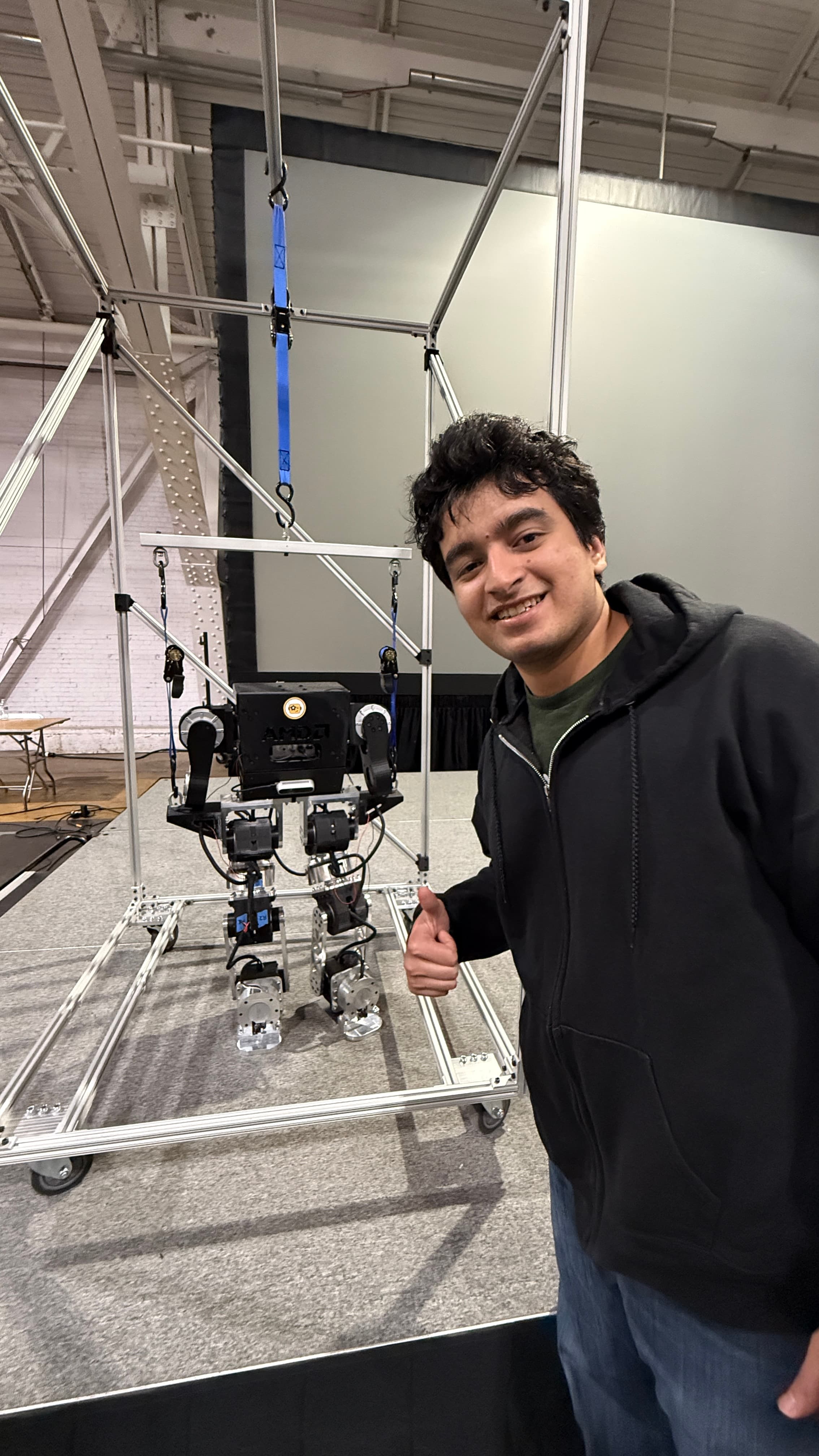
Pranav with a humanoid robot at an AMD robotics demonstration
Somewhere between research & reality.FIG. 01
A little newsOur VLA interpretability paper was accepted to NeurIPS.Read the paper

01 / Research & current work

From understanding
to action.

How do robots perceive their surroundings, learn useful behaviors, and act reliably beyond the lab? That’s the thread through my work.

NeurIPS — Neural Information Processing SystemsResearch publication
Accepted at NeurIPSVLA · Interpretability

Mechanistic Interpretability and Steering of VLA Models Through Sparse Autoencoders

Understanding what Vision-Language-Action models learn, and how we can steer their behavior. Co-authored research on mechanistic interpretability using sparse autoencoders.

Read the paper on arXiv
Vibe Robotics01

Real-time perception and hybrid control for humanoid robots

Real-time RGB-D perception, spatial mapping, and hybrid control that brings teleoperation and autonomous policies together.

RGB-D perceptionSLAMHybrid control
More about this work
  • Robotics Engineer Intern — RGB-D perception, point clouds, and SLAM-based spatial modeling for humanoid interaction.
  • Build real-time perception pipelines that turn raw sensor streams into structured scene representations.
  • Develop hybrid control systems combining teleoperation with autonomous policies for closed-loop execution.
SCALE Robotics Lab02

Vision-Language-Action models for closed-loop robot control

Learning robot policies from multimodal inputs, studying their failure modes, and connecting perception to closed-loop action.

VLA modelsImitation learningSim-to-real
More about this work
  • Trained VLA models (Open-Pi, OpenVLA, ACT) for closed-loop robotic control from multimodal inputs — imitation learning and RL for policy refinement.
  • Built perception-to-action pipelines integrating RGB-D sensing, SLAM, and state feedback for real-time inference.
  • Conducted sim-to-real experiments analyzing generalization gaps, failure modes, and robustness of learned policies.
  • Built a real-world Connect 4 robotic system combining VLA policies with classical control (Purdue Robotics Day demo).
  • Co-authored research on mechanistic interpretability and steering of VLA models through sparse autoencoders (SAEs).
  • Working on hallucination mitigation in video models for World Action Models.

02 / In the field

Real robots.
Real learning.

The interesting part happens when a model meets the physical world. A few moments from building, testing, and figuring things out.

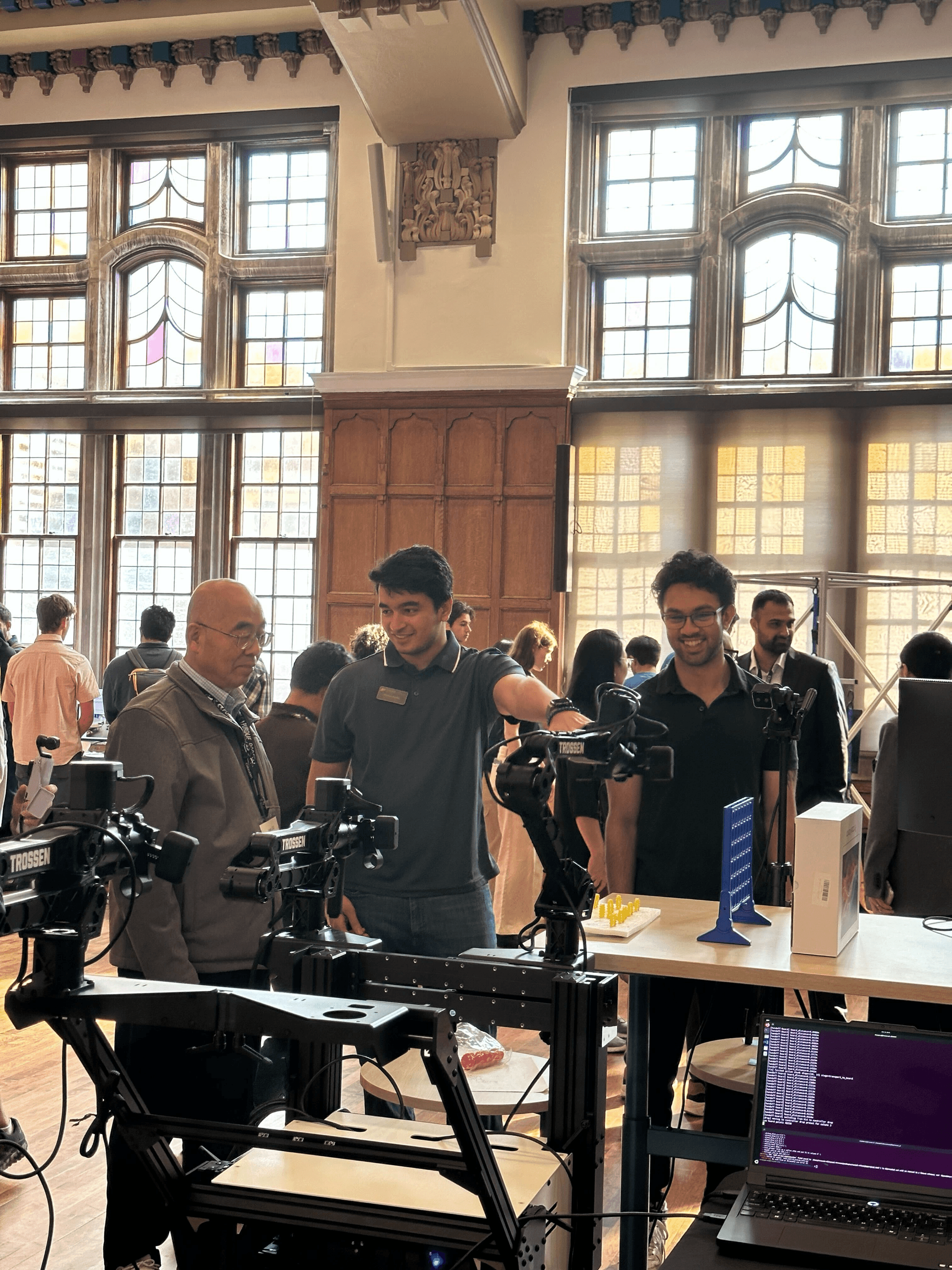
Pranav demonstrating robot manipulation and Connect 4 at Purdue Robotics Day

Field notes / Purdue Robotics Day

Taking research
off the bench.

A real-world Connect 4 system that brings learned VLA policies and classical control together. There’s nothing quite like a live demo to find out what actually works.

Watch the robots in action Perception → Policy → Action
Vibe Robotics01

Humanoids, hands-on

Building perception and hybrid control for humanoids. Built and trained in house — literally.

2× speed
Policy data collection02

Your move, SPOT.

A Connect 4 opponent, and a real-world data collection pipeline for policy training.

Vision-language-action03

A policy at play

Pi0.5 takes on Connect 4: learned policies, game interaction, and embodied decision-making.

A closer look / Selected projects

01
robot perception

RealSense to Unity 3D Perception & SLAM Pipeline

I built a real-time RGB-D pipeline from an Intel RealSense D435i for 3D reconstruction, SLAM-based localization, and spatial mapping in Unity.

02
VLA + classical control

Connect 4 Robot Demo

I built a real-world Connect 4 robotic system that combined learned VLA policies with classical control for Purdue Robotics Day.

03 / Experience

Different problems. Same curiosity.

From scientific ML to social systems and aerial robotics, each experience shapes how I build.

Agentic ML workflows for scientific analysis

Build agentic ML workflows with LangGraph and DSPy for automated scientific analysis, instead of one-off prompts. Focus on reproducibility — traceable, repeatable model outputs that scale beyond a single analysis run.

LangGraph, DSPy, scientific ML pipelines

Event pipelines and graph-based interaction modeling

Software Engineer Intern — re-architected high-throughput event ingestion pipelines for product behavior data. Designed graph-based interaction models for large-scale prediction systems, bridging product engineering and ML.

event ingestion, graph models, prediction systems

UAV perception and control systems

Worked on sensor fusion pipelines for stable real-time UAV flight. Early robotics systems work before moving deeper into ML for robot control.

UAVs, sensor fusion, real-time flight

04 / The toolkit

Tools for the job.

From training a policy to getting a robot to execute it.

Languages

Python · C/C++ · Java · R · JavaScript · TypeScript · SQL

Robotics / AI

ROS · SLAM · RGB-D Perception · Point Clouds · Sensor Fusion · VLA · WAMs · Isaac · MuJoCo

ML

PyTorch · TensorFlow · Reinforcement Learning · Imitation Learning · Computer Vision · LangGraph · DSPy

Systems

Docker · Linux · Flask · Node.js · React · MongoDB · Unity

Along the way / Recognition

A few highlights.

HackMIT

Citadel Challenge Winner

2025

NASA SUITS

Best Innovative

2025

Catapult Hackathon

Runner-up

2025

HackMIT

Top 12 / 250+

2024

Boilermake XII

Top 8 / 109

CS Base Climate Hackathon

Advance Tier Second Place

2024

Purdue Hello World

2nd place

2023

Indian National Mathematical Olympiad

National Team

Keep in touch

Good things start
with a conversation.

Robotics, research, or something worth building.
I’d love to hear what you’re working on.

cdtpranavkumar1126@gmail.com